My AI Predictions, Two Years Later: The Ones That Landed
In 2023 I published 50 mind-blowing ways AI will reshape our world in 2024. It came out of a long dinner conversation about where AI was heading, and I wrote it half expecting to look naive a year later. Predictions often age badly. That’s the whole risk of making them.
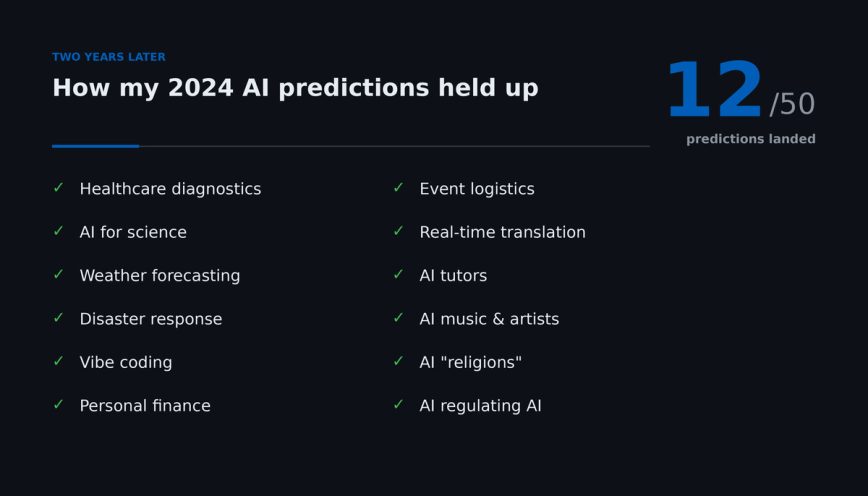
It’s been more than two years now, so I went back and checked every item. The honest result: plenty of the original 50 were too vague, and a fair number were really me pointing at apps in the process of being shipped. I’m not counting those.
Health and Fitness
1. AI reads medical scans faster than we do
I said AI would read scans like MRIs faster and more accurately than humans, catching disease earlier. That one was right, and I undersold it. The number of AI-enabled medical devices cleared by the FDA has passed roughly 1,500, and about three quarters of those are in radiology. Meta-analyses now put AI imaging detection at a sensitivity comparable to a trained radiologist.
These tools assist radiologists, they don’t replace them, and the best results still come from a machine and a human reading together. But as a call, this was the one I got most right.
2. AI turned protein folding into a Nobel Prize
I predicted AI would push real scientific discovery, though I framed it around quantum research, which was the weakest part of my wording. The reality went somewhere better. AlphaFold won the 2024 Nobel Prize in Chemistry, and the physics prize that same year went to the neural network pioneers behind modern machine learning. Two science Nobels in one year, both tied to AI. AlphaFold is now used by millions of researchers, DeepMind’s materials model turned up 2.2 million new crystal structures, and AI-designed drug candidates have entered human trials.
A predicted structure or candidate molecule still has to survive the lab and the clinic. AI shortened the search. It didn’t remove the years of testing that follow.
The weather and the world
I run dewedda.com, a weather and hurricane tracking site for the Eastern Caribbean, so the next two are the ones I watch most closely.
3. AI weather models overtook the physics
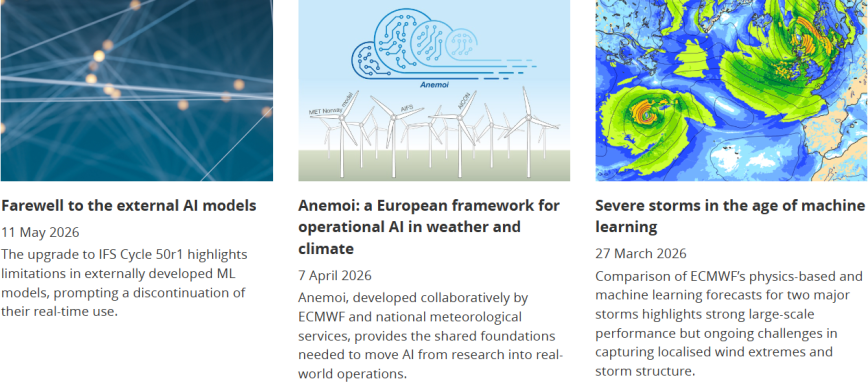
I said AI would deliver better, more personalized forecasting. What happened is bigger than that. AI models like Google DeepMind’s GraphCast and the ECMWF operational AI system now beat the traditional physics-based forecasts on the large majority of measured variables, at a fraction of the compute. The gold standard got beaten by a neural network.
Note, these models still struggle with extreme rainfall and fine, local detail, and for small islands that local detail is the whole game.
4. AI started predicting disasters before they hit
I predicted AI would optimize disaster response. It does that and more now. Google’s flood forecasting system covers over 460 million people and pushes warnings up to seven days ahead. After Hurricanes Helene and Milton in 2024, aid groups used AI tools to find the worst-hit, lowest-income areas first. In California, AI-assisted wildfire tracking became a source people actually trust.
Prediction isn’t prevention, though. A seven-day flood warning only helps if people can act on it, and that part is still human.
How we work and build
5. People started building software by describing it
I opened the original article describing a small business owner building custom software just by describing what they wanted, no code. At the time, that was the most science-fiction thing in the whole piece. It has a name now: vibe coding. Tools like Lovable, Bolt, and Replit turn a written description into a working, hosted app. Inside Google and Microsoft, roughly 30 percent of new code is AI-generated, and most engineering teams use AI daily. Also see how to stay ahead at work with AI.
Code churn and bug rates have climbed right alongside the speed, though. AI writes the first draft in seconds. Reviewing that draft is now the actual job.
6. Your bank account got AI that acts, not just advises
I predicted AI connecting to bank accounts, reading your spending, and giving real financial advice. That now exists. What I didn’t see coming was how far past advice it would go. Around 70 percent of banks are now using or piloting agentic AI, Mastercard, Visa, and PayPal have all launched agentic payment systems, and assistants like Fidelity‘s can execute trades once you approve them. Agentic commerce, where software shops and pays on your behalf, is projected to touch over a trillion dollars in spending.
Here’s where I’d pump the brakes. Only about 38 percent of bankers think the tech is ready for full autonomy. These are assistants with a human checkpoint, not fiduciaries, and you should treat them that way.
7. AI quietly took over event logistics
One of my safer calls, and it still came true. Around half of meeting and event planners now use AI day to day, and newer agentic tools go further: sourcing venues, comparing and negotiating vendor bids, even phoning registrants to confirm attendance.
No fully autonomous event planner exists yet. What works today is narrow, supervised tasks, with a human on anything that needs judgment.
How we learn and talk
8. Real-time translation stopped being science fiction
I said AI would break language barriers with real-time translation. It lives in earbuds and phones now. Google Translate and Samsung devices do live, two-way speech translation across more than 70 languages, and some systems even keep the speaker’s voice on a translated call.
It’s good, not perfect. Idioms, names, and technical jargon still trip it up, which is right where a human interpreter still earns the fee.
9. AI became a real tutor, not a gimmick
I predicted AI that adapts to how each student learns. The clearest proof is scale. Khan Academy’s AI tutor went from tens of thousands of pilot users to more than 700,000, with school districts and federal funding behind it, and Duolingo built well over a hundred new courses with generative AI in a single year.
Adoption isn’t the same as learning, though. The long-term studies on whether students come out knowing more are still coming in, and I’ll believe the gains when I see them measured.
Culture, belief, and machines watching machines
10. AI artists started charting with real listeners
I predicted AI would help compose music. I aimed way too low. There are now fully AI-generated acts, with personas, album rollouts, and real audiences. One AI band pulled around 1.4 million monthly listeners on Spotify before anyone clocked that it wasn’t human, and a major producer launched a whole company whose first signing is an AI artist. Suno alone passed 100 million users. Spotify had to rewrite its rules to require AI disclosure and pulled tens of millions of spam tracks.
So yes, “AI helps with music” was correct. It was also a wild understatement.
This one’s a fight, not just a milestone. The major labels are suing AI music generators, and plenty of human musicians are pushing back hard. Whether you call it a win depends entirely on which side of that you’re standing on.
11. Some people started treating AI as a religion
This sat near the bottom of my original list, and it turned into one of the strangest hits of the whole thing. Small movements have formed that treat AI as a spiritual authority or a gateway to one, with names, followings, and in at least one case an AI-run confessional booth in a church.
It’s fringe, and I don’t want to overstate it. It’s real and growing, but it isn’t mainstream, and I hope it stays that way.
12. AI started regulating AI
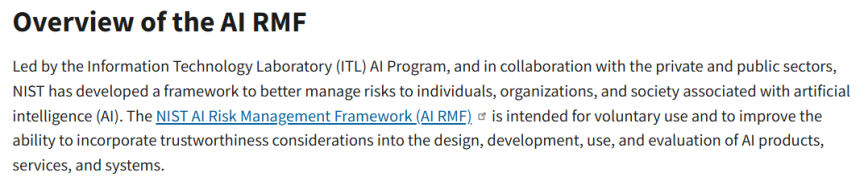
I predicted AI would eventually be governed by AI, which sounded circular when I wrote my piece on AI regulating itself. But AI agents are pointed at other AI systems to find their flaws, guardrail models supervise other models in production, and frameworks like NIST’s AI Risk Management Framework now expect this kind of automated testing.
The uncomfortable part: some researchers argue that “AI safety” run by AI becomes a way to dodge real human oversight rather than add to it. A machine checking a machine isn’t the same as accountability. I think they have a point.
Bonus: the one I’m slightly embarrassed by
AI plans your trip and packs your bag
This came true. Surveys now put around 80 percent of travelers using generative AI to plan trips, and Expedia, Google, and Kayak all ship AI itinerary and packing tools.
The tools still confidently invent closed restaurants and wrong driving distances, so this is a first-draft helper, not a final word. Check before you book. The filler prediction aged better than some of the serious ones, which probably tells you something about predictions.
What I got wrong, and what it means
I’m not going to pretend the whole list aged this well. A lot of the 50 were too vague to score, a few were wishful, and some were everyday apps. What surprised me is the shape of it. The boring, safe calls like packing assistants came true on schedule. The strange ones I almost cut, AI religions and machines auditing machines, landed hardest. And the single best call, healthcare diagnostics, was right for reasons more serious than I understood when I wrote it.
I’ll do this again. If you want to grade me honestly, the original list of 50 is still up.